Monday, July 6, 2009

MakeMeSustainable Monday: Free Rides

Welcome to our new Monday-morning blog feature, where we share easy tips and DIY projects that you can use this week to help make your life a bit more sustainable!

If you haven't already setup your sustainability profile at MakeMeSustainable, you can start by visiting http://makemesustainable.com. If you live in Chapel Hill/Carrboro, you'll automatically join our local group!

This week's project: Go car-free
A wise woman once told me: "All days from hell begin with a car." After experiencing a few car issues, I was starting to see the logic in her statement. Empty tanks, traffic jams, "check engine" lights, and fender-benders all strain our patience and our wallets. So how realistic is it to go car-free on a regular basis?

Very realistic! Especially in Chapel Hill. Learn from my experiences and give it a try yourself this week. The weather is beautiful and everything I mention here is FREE. I've been living car-free for over a year now, and have saved both my money and my sanity.

Tips:
  • All Chapel Hill Transit buses are FREE. You don't need a special card or anything - just walk on!
  • If you need to travel outside Chapel Hill (e.g. commuting from Durham or Raleigh), there are special Triangle Transit express buses. You can ride these for FREE as a UNC student or staff by signing up for UNC's Commuter Alternatives Program (http://www.dps.unc.edu/Transit/gettingtowork/gettingtowork.cfm).
  • You can also join CAP for a 30-day trial without giving up your parking permit. You will not be able to take advantage of the $20 vanpool subsidy, or the free annual Triangle Transit GoPass. You will receive a Park & Ride decal, giving you access to 5 additional park & ride lots and a membership card, opening the door to discounts with several area merchants and a chance to win prizes distributed at random throughout the year. Call 962-3951 and ask to speak to someone about the trial CAP program.
  • If you are not within walking distance of a bus-stop, consider using your bike to get to a bus stop. All Chapel Hill Transit and most other area transit systems have easy bike racks on the front of all buses. Just pull down the rack, load your bike, and lift the tire guard over your tire to secure the bike.
Step-by-step guide to start living car-free:
  1. Make a list of your usual destinations and arrival times. For example, I make 3 trips per day. I go from my home to my office at 8. I go from my office to campus at 3. I go from campus to my home at 6.
  2. Enter those routes and times in the online GoTriangle Trip Planner (http://www.gotriangle.org/trip/en/). This website uses the current scheduling information from all the Triangle-area transit systems, so it is an excellent resource.
  3. Based on your travel information, GoTriangle will give you multiple itineraries for your trip. These include bus routes, times, a map, and sometimes pictures of the bus stops. I recommend printing or copying the information for at least 2 of the proposed itineraries. That way you have a back-up in case a bus (or you!) is late.
  4. Pack your things in a single, easy-to-carry bag, such as a backpack or canvas bag. I also recommend packing a magazine or bringing your MP3 player to entertain you on the bus ride.
  5. Arrive at least 5 minutes early to the bus stop just to be safe. And don't panic if the bus is a few minutes late. If you have internet access, you can always check NextBus to make sure your bus is on time (http://www.nextbus.com/predictor/stopSelector.jsp?a=chapel-hill).
  6. Don't forget to ring the "Stop Request" bell about a block before your desired destination. On most buses this is plastic yellow strip by the window OR a cord hanging in front of the windows.
Going car-free is a simple, inexpensive, stress-free way to get around Chapel Hill! Once you start learning the major routes and stops, you'll be able to easily navigate your way around town. No more parking pains, no more gas guzzler, not more wasted time in traffic!

Friday, July 3, 2009

The Really, Really Free Market is really, really free...really!

On the first Saturday of every month from 2:30 to 5:30 PM, people of all ages, sizes, and interests gather in a corner of Carrboro for socializing, for community spirit, and for free stuff. Some people come with treasures to be passed on: bags full of clothes, candlesticks, tapestries, strange books, lunch boxes, lanterns, or fragments of electronics. Others come empty handed to hunt through the piles of old belongings.

Some things are ragged and torn, while others are brand new: I have seen everything from old family photographs to a shiny red unicycle. There is food laid out on tables, thousands of items lining the sides of the covered walkway, pamphlets and literature for the taking, and even signs for free haircuts or hugs. Best of all (you guessed it): everything is free.

At the heart of the Really Really Free Market is a community supporting itself and keeping goods from going to waste. You don’t have to bring anything to offer—I didn’t the first few times I went—but it’s more fun when you can smile as, ten minutes after you arrive, a 5-year-old parades down the sidewalk ten minutes later with your old scarf tied around his head. You’re also welcome to take whatever you see, and if you don’t like it later, bring it back next time!

The official website states that “everyone is welcome” and “encouraged to give, receive, and create on their own terms.” There are no rules, no buying, selling, or exchanging, and absolutely no price tags!

For information and pictures, visit: http://www.carrboro.com/reallyreallyfreemarket/

Thursday, July 2, 2009

Home-Grown 4th of July!


Looking for a way to spend July 4th weekend, but want to stay local?

Then consider going to the West Point on the Eno by the Durham City Park any time this upcoming Friday, Saturday, and Sunday for the Festival for the Eno. The festival is sponsored by the Eno River Association which is dedicated to the preservation of the nature, culture, and history of the Eno River basin. The festival includes over 80 musical performances, 15 food vendors, and tons of activities such tours, crafts, and workshops. They are also featuring a Sustainable Home and Garden Expo! It is sure to be fun for the whole family!

Get details at:
http://www.enoriver.org/Festival/index.html

Wednesday, July 1, 2009

Carolina in the News: Green Stories

Check out these recent UNC stories:

EPA renews UNC air quality modeling contract for $5.7 million
The University of North Carolina at Chapel Hill’s Institute for the Environment has been awarded a $5.7 million contract with the Environmental Protection Agency to continue and expand their operation of the Community Modeling and Analysis System (CMAS) center.
http://uncnews.unc.edu/content/view/2672/107/

‘Environmental Heroes’ to air on UNC-TV July 4
A documentary produced by the University of North Carolina at Chapel Hill School of Journalism and Mass Communication science documentary television course will air Saturday (July 4) at 11 p.m. during the “North Carolina Visions” film festival on UNC-TV (North Carolina Public Television).
http://uncnews.unc.edu/content/view/2675/74/

Students to document water program
The Chapel Hill Herald
Five UNC students are traveling to the other side of the world July 2-31 to document on film the impacts of the work of WaterPartners, a nonprofit organization with its roots in North Carolina that empowers people in developing countries to gain access to clean water.
http://heraldsun.southernheadlines.com/orange/10-1176061.cfm

Business interns after the new green
The News & Observer (Raleigh)
Lindsay McCombs has a summer internship that shows a different face of capitalism. Instead of taking the usual route -- corporate finance, investment banking, or marketing -- the UNC-Chapel Hill business student will spend her summer as an energy conservation consultant for Grubb Properties, a real estate management firm in Raleigh. She's one of 26 MBA students nationwide, including three in the Triangle, who are advising businesses for 10-week stints on how to cut costs by cutting energy waste. The Climate Corps summer internship program was created by the Environmental Defense Fund and is in its second year, attracting students who want to have energy expertise on their résumés.
http://www.newsobserver.com/business/story/1576442.html

'Green Plus' businesses recognized
The Chapel Hill Herald
UNC's Institute for Sustainable Development has recognized two Research Triangle region businesses as Certified Green Plus: Bland Landscaping of Apex and Zemo Trevathan & Associates of Chapel Hill. ...The overall business plan for Green Plus was commissioned by UNC Chapel Hill Vice Chancellor Tony Waldrop in 2007. The Center for Sustainable Enterprise at UNC's Kenan-Flagler School of Business developed the plan, and a partnership of UNC, Duke, and chambers of commerce built and tested the program with small businesses in North Carolina and Ohio in 2008.
http://heraldsun.southernheadlines.com/orange/10-1173268.cfm

Local high school students to experience "green" summer camp on UNC campus
UNC News
Two dozen high school students from Chapel Hill and Carrboro are taking part this week in “Climate LEAP,” a climate change and energy workshop on the University of North Carolina at Chapel Hill campus. During the week-long workshop, designed by the UNC Institute for the Environment’s Environmental Resource Program, students will take part in hands-on activities such as experiments, computer data modeling and games.
http://uncnews.unc.edu/content/view/2638/74/


-Thanks to UNC News Services for finding these great stories! You can find more UNC media coverage and stories online at:
http://uncnews.unc.edu/content/category/8/34/103/

Tuesday, June 30, 2009

Carolina North APPROVED!

In case you missed the most recent DTH headline, the Chapel Hill Town Council has approved the development agreement for UNC's new research campus. This is BIG NEWS for UNC, as it now begins to develop the 250-acre campus.

So what does this have to do with sustainability? Everything. Chancellor Thorp said it himself:
"Carolina North will be a model of sustainability, a place to apply our environmental research in a real-world scenario, to explore new energy sources and technology, to push the envelope on smart design. This new campus will not only help us to retain our best and brightest, it will also be a magnet to attract quality faculty, staff and students to North Carolina."
This new campus, as currently planned, will include a central green way, working landscapes, public transit, undeveloped forest, and more. You can read the design guidelines online at:
http://research.unc.edu/cn/Design_Guidelines.pdf

To read the Chancellor's full Opinion in the Herald-Sun, visit:
http://heraldsun.southernheadlines.com/opinion/columnists/Thorp/112-1176052.cfm?

To learn more about Carolina North, visit:
http://research.unc.edu/cn/index.php

Monday, June 29, 2009

MakeMeSustainable Monday: Solar Power

Welcome to our new Monday-morning blog feature, where we share easy tips and DIY projects that you can use this week to help make your life a bit more sustainable!

If you haven't already setup your sustainability profile at MakeMeSustainable, you can start by visiting http://makemesustainable.com. If you live in Chapel Hill/Carrboro, you'll automatically join our local group!

This week's project: solar power for cellphones & radios!
While efficiency and battery technology still have a long way to go, solar power is still the most attractive of the many sustainable technologies to many consumers. For most folks solar energy makes good sense - tap the solar energy all around use to reduce dependence on energy from the traditional electrical grid, which is usually produced by coal or nuclear power.

If you're interested in experimenting with solar power, consider this:
  • It takes a lot of energy to actually produce a solar panel. If you want to reduce your environmental impacts, consider using a "reclaimed" solar panel for your projects. This can be as small as the panel inside those little garden lights, or as big as decommissioned highway panels. Some tips on finding a decommissioned panel can be found here.
  • Solar panels are actually more efficient and will generate more power in colder temperatures. Excessive heat does not mean greater power.
  • Any DIY project with electricity will require a bit of technical knowledge (e.g. using a soldering iron) and some safety precautions. Don't be scared to learn something new. Do, however, read all instructions carefully and make sure you are safe!
Ok, ready to get started?

To make a solar powered cell phone charger, go to:
http://www.instructables.com/id/Solar_Powered_Cell_Phone_Charger/

To make a solar powered radio, go to:
http://www.instructables.com/id/DIY-Solar-Powered-radio-for-%245/

If you're ready for the big leagues, check out Planet Green's "7 Great Weekend Solar Power Projects." It includes the aforementioned projects AND more complex projects like a solar powered boom box!
http://planetgreen.discovery.com/tech-transport/solar-projects-weekend.html

Friday, June 26, 2009

"E-Cycling" event TOMORROW


With the switch to all-digital television, many folks are replacing their old television sets. But old electronic equipment does not have to go to the landfill, because it can be recycled! Fox 50 is hosting an "E-Cycling" event TOMORROW on Saturday, June 27 in order to promote the responsible recycling of electronics. They are hosting the event at three locations across the Triangle area for convenience. The event will be held from 10 am-2 pm in the parking lot of the following locations:
  • Durham - Renaissance Center (7001 Fayetteville Rd, Durham, NC 27713)
  • North Raleigh - Capital Blvd. (6101 Capital Blvd, Raleigh, NC 27616)
  • Cary - Crossroads Plaza (237 Crossroads Blvd, Cary, NC 27518)
Check out the website below for examples of what to bring and more information:
http://www.fox50.com/dpp/community/E_Cycling_Page

Tuesday, June 23, 2009

18 Tips for Green Pest Control

In this beautiful weather, I like sitting outside on my porch. How do I keep from getting eaten alive by mosquitoes without spray poisons and carcinogens all over my body?

I live in an old house and have a mice problem. How do I get rid of the mice without poisoning all wildlife?

Something (or someone) is eating the vegetables in my little backyard garden. What's a humane solution?

This recent post at WebEcoist is light on details, but heavy on ideas to get you thinking about "green" ways to control pests. Now if you'll excuse me, I'm off to find some Citrosa Geranium for the back porch!
http://webecoist.com/2009/06/12/18-tips-for-super-green-pest-control/

Monday, June 22, 2009

Jobs. Green Jobs.

Are you blue from not yet finding a job after graduation? Well recent grads might want to start looking green!

Green-collar jobs are one of the fastest growing sectors in the United States. PEW Research Company recently released information that supports that the number of green jobs are rising. The industry has grown 9% a year, which is more than twice the amount of growth in the traditional job industry. "With all the emphasis in the stimulus and energy bills, there's going to be new demand and a lot more investment in these businesses, which will mean more jobs," said Joel Yudken, a member of an advisory panel for the Pew study, in an article in the Wall Street Journal. "It's a growth area, there's no question about that."

Find more information about green job opportunities and openings at any one of the following websites:
http://www.greenjobs.com
http://www.greenjobs.net
http://www.sustainablebusiness.com

Thursday, June 18, 2009

The Carbon Counter

No longer can the citizens of NYC only watch a counter clicking the US further into debt on the National Debt Clock. A new, similarly depressing display just opened a few blocks away, and is known as The Carbon Counter. It shows the amount of greenhouse gases being pumped into the Earth’s atmosphere every second—at an alarming rate.

At 70 feet high in a prime location outside of Madison Square Garden and Penn Station and with a current display of over 3,600,000,000,000 metric tons, it is impossible to ignore. This is exactly what the creator, Deutsche Bank, desires. By helping people recognize the reality of climate change, the bank hopes to inspire change.

And how about the sign itself? It uses low-energy LED lights and is offset by carbon credits.

To view the clock, and find out what you can do to turn back the numbers, visit: www.dbcca.com

Eats 101

image copyright http://www.Eats101.com

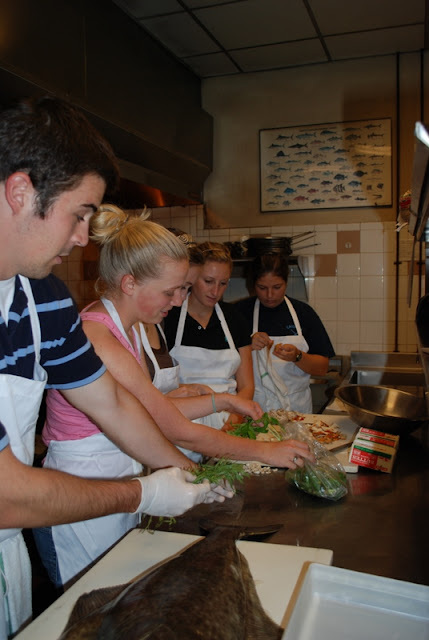
Since this week is all about food and gardening, it's a happy coincidence that we just learned about a really cool sustainable food-related course here at UNC. Yes, I said sustainable FOOD-related COURSE! Here's the overview:
Since its inception in 1997, UNC’s Honors Seminar in Food and Culture (HNRS 352-001—aka “Eats 101”) has explored cultural, social, economic, and environmental sustainability through the lens of historical and contemporary food practices. Designed as a fourth hour “lab,” the new sustainability section connects students with sustainable food initiatives at home and abroad in addition to facilitating hands on experience with food production, acquisition, and preparation.
Awesome!! Students in this course have made site visits all around town (e.g. Carrboro Farmer’s Market, Counter Culture Coffee, Chapel Hill Restaurant Group, Peregrine Farms, Chapel Hill Creamery, SEEDS, Baldwin Farms, Weaver Street Bakery/Market), hosted and prepared a dinner at the first Southeast Regional Food Activist Summit Conference, and even presented at the Oxford Symposium on Food and Cookery.

Special thanks go to Professor Jim Ferguson, who developed this course, and Lauren Wilson, a Food Studies major in Interdisciplinary Studies and French major at Carolina, for bringing our attention to this course!

Holy cow, I wish I was in the course! Learn more about Eats 101 online at:
http://www.eats101.com/

image copyright http://www.Eats101.com

Wednesday, June 17, 2009

Upside-down gardening

Although summer doesn’t technically begin for another ten days, it’s still a perfectly appropriate time to start that summer garden you’ve been dreaming about all winter. Don’t worry if you don’t have much of a yard to work with, or even a yard at all! A fun type of tomato gardening that’s recently been sweeping the nation’s porches and patios only requires a container (like a 2 liter soda bottle), some soil, string for hanging, a place for it to hang from—and, of course, the baby tomato plant itself.

For directions on how to make your own upside-down tomato plant holder (also known as “inverted tomatoes” or “topsy-turvy tomatoes”), visit: http://www.ehow.com/how_2280899_make-down-tomato-plant-holder.html or http://www.curbly.com/DIY-Maven/posts/1620-how-to-make-an-upside-down-tomato-planter or http://www.cheapvegetablegardener.com/2009/04/make-your-own-upside-down-tomato.html .

Upside down gardening not only looks great; it’s great for the environment too! Hanging baskets generally don’t have weed or pest problems, so chemical care is unnecessary. It’s even said that tomatoes develop faster hanging than growing from the ground up. Plus, it’s so fun that the neighbors will want to try it too, and soon everyone will be growing their own local and delicious spaghetti sauce, savory salsa or tasty tomato bisque!

Tuesday, June 16, 2009

Buying local and community gardens!

While yesterday's post was all about the importance of having a home garden, it is definitely true that not everyone can have a home garden. So what to do?

1) Buy locally produced food - including milk, produce, meat, bread, eggs, etc. That means is has been produced within 150 miles. When you buy local, your food will be fresher, there will be less pollution transporting food, AND your money will stay in the local economy. It's a win-win-win scenario!

Even if you live and/or work on UNC's campus, there are lots of opportunities to "eat local":


2) Seek out a community garden! UNC has the Carolina Garden Co-Op with multiple plots. Nearby is also the Northside Community Garden at 400 Caldwell St., and the Carrboro Community Garden within Carrboro's Martin Luther King Jr. Park on Hillsborough Road. Community gardens are great ways to meet other interested community members AND get yourself some real-life gardening experience!

Monday, June 15, 2009

White House Garden Tour!

"As raw as it gets!" -Ryan Howard of the Philadelphia Phillies


It's great the our First Family now has a garden of their own, but having a garden is nothing new. Remember the WWII "victory gardens"? With the economy down and prices up, these economically- and environmentally-beneficial landscapes are making a comeback!


Are you gardening? I know I am!

Friday, June 12, 2009

Why is "stuff" so complicated?

Check out this gem from a recent Bill Moyers interview with Daniel Goleman!

DANIEL GOLEMAN:
"...The riddle of the chariot comes from the 5th century, from an obscure text in India.....It poses the question: where is the chariot? Is it in its wheel? In the frame? In the rods that connect it to the horse? It's not in any one of those. It is an aggregate of parts.

"And the metaphor here is that any product is not a single thing here. It has a back story. It's an aggregate. It's an assembly. And that assembly includes the impacts along the way. So we've got to expand our thinking about the stuff we buy. Because it has a history that could be better going into the future if we vote with our dollars. And that's another metaphor I'd like to put out. Is that it's like an election, folks, you know. Do you want the...pricy one with the chemicals of concern?

"Or do you want the one that's actually cheaper as it happens, and that you know is safe for your family. And if you do, and, as you say, if you have a broader moral vision, do you want to let other people know? Do you want to make the company know, so that by the time your grandchildren are buying it, it's a safer product."
A very interest discussion on the importance of knowing the "true costs" of the products we buy. But how can we tell what products are "safe" or have the smallest impact on people and the environment?

Fortunately, Mr. Goleman pointed to 2 excellent (and easy to navigate) online resources to help you quickly find the better products!

http://www.goodguide.com/ (easy ratings guide to find the preferable products)
and
http://www.cosmeticsdatabase.com/ (what potentially dangerous chemicals are in your cosmetics?)

Hat tip to Greg Gangi, of UNC's Institute for the Environment, for pointing this out!

Wednesday, June 10, 2009

What's our true footprint ?

Time-lapse photography and aerial photography - both can create stunning visuals of natural processes. And together, they can also give us a true sense of the human impact on our environment. Wired Science has put NASA aerial photographs together to create time-lapse videos that show our true footprint on Planet Earth.

Urbanization: Dubai


Water consumption: Aral Sea


Deforestation: Amazon


For more time-lapse videos and information, check out Wired Science at:
http://www.wired.com/wiredscience/2009/05/earthobservatoryvideos/

Tuesday, June 9, 2009

"Home"

Did you know that June 5th was World Environment Day? This year's World Environment Day occurred on a Friday and featured a major event. An awareness documentary called "Home" was released on Friday simultaneously in 100 countries. According to an article by Anne Chaon of AFP, it is documentary about saving the planet brought to you by director/photographer Yann Arthus-Bertrand.


The director said in the article that "the idea is to explain what's happening to the planet by beginning at the beginning, by the miracle of life on earth." It took three years to complete and features stunning aerial shots. He said of his desire to complete the film that "although there's a general trend towards an awareness of ecological issues, concrete action is still too little, too slow." In an attempt to maximize awareness, the complete film is available for FREE viewing online until June 14!

Check it out online at http://www.youtube.com/homeproject.

Monday, June 8, 2009

The World We Avoided...


If you caught the ABC special "earth 2100" last week, you were treated to a frightening version of the world as it could be if humans do not act quickly to address issues such as global warming and population growth. But how real are such scenarios? Unfortunately more real than some might like to believe.

To this end, atmospheric chemists from NASA’s Goddard Space Flight Center, the Johns Hopkins University, and the Netherlands Environmental Assessment Agency ran a simulation of “what might have been” if chlorofluorocarbons (CFCs) had not been banned with the 1989 Montreal Protocol.

In summary:
"The year is 2065. Nearly two-thirds of Earth’s ozone is gone—not just over the poles, but everywhere. The infamous ozone hole over Antarctica, first discovered in the 1980s, is a year-round fixture, with a twin over the North Pole. The ultraviolet (UV) radiation falling on mid-latitude cities like Washington, D.C., is strong enough to cause sunburn in just five minutes. DNA-mutating UV radiation is up more than 500 percent, with likely harmful effects on plants, animals, and human skin cancer rates."

Read all about it online at:
http://earthobservatory.nasa.gov/Features/WorldWithoutOzone/page1.php

Wednesday, June 3, 2009

Your input needed for UNC Sustainability Report!


Does your University group or department have any programs, research, or accomplishments that promote sustainability?

If so, we would like to include your university group/department’s accomplishments in the upcoming 2009 Campus Sustainability Report, which reaches a wide audience of elected officials, educational leaders, government agencies, and local and regional organizations and thought leaders. The report will highlight sustainability-related accomplishments, trends, awards, and activities across the University. The report is focused on documenting new actions and their impacts. Thus it will cover progress made in policies, practices, curriculum, research, engagement, and funding since fall 2007. Longer term trends are also of interest in order to measure progress over time. A copy of the 2007 report is available online at http://sustainability.unc.edu.

You may submit information by completing the easy online form at:
http://www.surveymonkey.com/s.aspx?sm=VgDLk6GUTmrU5ubIweTYDg_3d_3d

The deadline for submissions in June 10, so don’t delay!

Tuesday, June 2, 2009

Treasured Results

As some of you may have seen in the Daily Tar Heel, the Tar Heel Treasure sale was a wonderful success! Over 14.5 tons of goods were collected, $7,000 was raised for the Carson Scholarship, $1,000 worth of items were donated to the N.C. Children’s Hospital, and hundreds of wonderful community partners and volunteers worked together to make a wonderful sale!

Continue the conservation by keeping reusable items out of the trash. Donate used items to places like our local PTA Thrift. If you have a book, DVD, CD, or video game, you could even trade your item for another through websites like SwapTree.com (Eco-hint: use minimal packaging and ship/receive locally). And always, always recycle!

By reusing items and reducing waste, you’re saving natural resources and landfill space. In other words, reuse, reduce, recycle, and save the world!

To learn what items are recyclable in Orange County, visit http://www.co.orange.nc.us/recycling/community.asp.

To learn more about trading items online, visit www.swaptree.com.

Friday, May 29, 2009

Learning in LEED spaces

It seems like UNC-Chapel Hill always has some sort of building under construction. Many other schools and universities are going through construction or remolding as well, and also starting to design with sustainability in mind. Da Vinci Arts Middle School in Portland, Ore. is one example that was mentioned in a recent New York Times article. An architect firm designed a classroom in the school to include natural daylighting, solar panels, and other sustainable features. This school has designed the classroom in such a way to try and receive a LEED-Platinum certification.

Speaking of LEED-Platinum certification, the North Carolina Botanical Garden's Education Center, opening later this year, has also been designed for LEED-Platinum certification, which only a dozen or so other buildings in the country have qualified for including three in North Carolina.

Check here to read the complete New York Times article:
http://greeninc.blogs.nytimes.com/2009/05/28/shining-a-natural-light-on-green-schools/?scp=3&sq=green&st=cse

Check here to see more information on the Education Center:
http://sustainability.unc.edu/Buildings/CampusBuildings/NCBotanicalGardenInConstruction/tabid/112/Default.aspx

Thursday, May 28, 2009

Sustain-a-FUN!

Did you know NC has one of the highest rates of power consumption in the US? Or that the average American throws out 4 pounds of trash every day? Or that coffee is the second most heavily-traded and highly-traveled commodity in existence (after oil)?

You can learn facts like these and discover more about your personal ecological footprint by playing “Consumer Consequences.” This fun online game lets you input data about your lifestyle—like the foods you eat, your electricity bill, and how you get to work—and witness the corresponding effect on the world. With each question comes a new sustainability-related fact, and a new change in the digital environment. See the world stay green, or watch as coal plants and factories take over the horizon, landfills and highways fill the neighborhood, and pollution clogs the air—that is, if you’re living unsustainably!

In the end, a final calculation shows how many Earths it would take it would take to sustain the world’s population if everyone lived just like you. A graph further pinpoints areas to work on. I tried it: turns out I use up 1.7 Earths!

Can you beat my score? Or should we start heading to Mars?

(Click here to play!)

Thursday, May 21, 2009

Higher Fuel Economy Standards

Big change is about to hit the road. On Tuesday, May 19th, Obama announced new standards for fuel efficiency and emissions, which will start taking effect in 2012. The new rules will require all cars to get at least 39 mpg and trucks to get 30 mpg, which averages to 35.5 mpg (as compared to the current average of 25 mpg).

On the national end, these new standards will save the US almost 2 billion barrels of oil from 2012 through 2016. Also, the newly efficient vehicles will prevent 900 million metric tons of greenhouse gases from being emitted throughout their lifetimes, which is akin to taking 177 million cars off the road. Auto industries are happy too, because now they have a single nationwide standard that helps national security, air quality, and general public approval. Sure, this means new cars will cost more—an average of $1,300 per vehicle—but at current prices a consumer can make that money back in gas savings in about 3 years.

Obama couldn’t have said it better: “In the past, an agreement such as this would have been considered impossible. That is why this announcement is so important, for it represents not only a change in policy in Washington, but the harbinger of a change in the way business is done in Washington.”

For more information on fuel economy, visit http://www.fueleconomy.gov/.

Wednesday, May 20, 2009

A New Green Movement: Transition


England native Rob Hopkins saw how oil dependency and the climate
crisis could be particularly devastating for the future’s well being.
That is why he and others began forming the Transition Initiative which
focuses on making communities resilient in a post-carbon world,
basically making them sustainable communities. In Hopkins’ book, The Transition Handbook: From Oil Dependency to Local Resilience, he offers
a change that communities could make to generate their own power, to
grow their own food, and more in order to prepare for what happens when
oil runs out. The Transition movement is gaining momentum here in the
U.S. with training conferences in Minnesota, California, Florida, and
Maine occurring throughout the summer.

Check out the flyer below for information on what a training conference
would consist of and go to the following website if you want more
information about the Transition Initiative in the U.S.

http://www.transitionus.org/about-us

Monday, May 18, 2009

UNC's RESPC makes the news!


A recent online news blog entitled "GREEN FEES: College Students Demand To Pay Their Own Way To Renewables" has a list of universities with on & off campus green energy student fees. No surprise that UNC was included on that list! Here is the complete list, courtesy of Dave Burdick at The Huffington Post:
ON-CAMPUS AND OFF-CAMPUS PROJECTS
The Evergreen State College
Middle Tennessee State University
Tennessee Technological University
University of Illinois at Urbana-Champaign
Auraria Campuses: University of Colorado at Denver, Metro State University and Community College of Denver
University of Oregon
University of Wisconsin, La Crosse

ON-CAMPUS PROJECTS ONLY
The College Of William and Mary
Northeastern Illinois University
Northland College
Appalachian State University
Bemidji State University
University of Colorado at Colorado Springs
University of North Carolina-Chapel Hill
Read the complete news blog here:
http://www.huffingtonpost.com/2009/05/12/green-fees-college-studen_n_201978.html

Read more about UNC's green energy student fee here:
http://respc.unc.edu/

Friday, May 15, 2009

One man's trash is another man's Tar Heel Treasure

Are you in need of some cheap summer clothes? A gently-used mini-fridge? How about a lamp and a shelf to put it on?

If you said yes, you’re in luck! A new initiative on campus called Tar Heel Treasure has saved these and other used items from the annual end-of-semester trash heap and will soon sell them back to the community at yard sale prices. By collecting everything from futons to flip-flops, they have diverted a huge volume of perfectly usable items from the landfill.


Best of all, the proceeds will be donated to good places—the Eve Carson Memorial Fund and the UNC Children’s Hospital—so you can shop with the knowledge that you’re helping our environment and our community!

The sale starts this Saturday, May 16th at 7:30 AM and lasts until 3 PM (cash only). It will be located indoors on Municipal Drive off of MLK. For details and directions, please visit their website, http://tarheeltreasure.unc.edu.

Come see what treasures you can find!

Thursday, May 14, 2009

Recycled art fund-raiser for Carolina Family Scholarship program

These whimsical "Techie People" were the table centerpieces for the recent annual UNC IT Awards. Diana Woodhouse, artist and web guru for Housing and Residential Education on campus, created these, and they are now for sale, with the proceeds going to next year's IT Awards ceremony and the Carolina Family Scholarship Program. Check 'em out! Auction closes Friday, May 15th, at noon.

Check them out and bid at:
http://fuji.ovcsa.unc.edu/techies/

Wednesday, May 13, 2009

New reclaimed water system brings water savings to UNC and the community!

This past Monday, May 11, UNC-Chapel Hill held a celebration and unveiled their new reclaimed water system that includes a 600,000 gallon concrete storage tank and will be able to have an output the equivalent of 10% of the surrounding community's water demand. UNC-CH partnered with Orange Water and Sewer Authority (OWASA) and received grants and funding from the North Carolina Clean Water Management Trust Fun and U.S. Environmental Protection Agency. All parties involved were represented at the event as Roger Perry, UNC-CH Board of Trustees Chair, Ed Kerwin, OWASA Executive Director, Philip A. Baddour, Jr., Clean Water Management Turst Fund Board of Trustees Chair, and David Price, U.S. House of Representatives, spoke at the ceremony. A tour of the facility followed. Check out the pictures below!

For more detailed information about the reclaimed water system, visit:
http://www.owasa.org/Documents/DocView.aspx?IDX=1095


Tuesday, May 12, 2009

April in North Carolina


The past month, North Carolina has been full of nature-related events! Environmental Education Week was April 12-18, then Earth Day on April 22, and finally Arbor Day on April 24. How did communities all over the state celebrate these events?

The NC Office of Environmental Education set up a website with event pictures from all across the state. Check 'em out at:
http://nceeweek2009.blogspot.com/

Monday, May 11, 2009

LEED Platinum, 100% Solar Powered, Affordable Housing

Sounds too good to be true?
Well, it's true! And it just opened in San Diego, CA. According to the press release:
"Los Vecinos Apartments, a $17.6 million, 42-unit complex in Southwest Chula Vista, was designed and built to achieve LEED* Platinum certification for energy savings and efficiencies. The project features an extensive solar power system that will provide nearly 100 percent of the development’s electricity.

"Other design features include the heavy use of ceiling fans and natural ventilation instead of air conditioning. Tankless hot water heaters, Energy Star appliances and high-efficacy lighting fixtures will keep energy costs to a minimum. Landscaping and irrigation techniques and low-flow fixtures will minimize water use.

"Los Vecinos consists of 1-, 2- and 3-bedroom units on three floors as well as a 1,500-square-foot community center, where residents will have access to programs on health and wellness, finance and computer literacy and “going green.” Families earning between $16,600 and $58,800 will reside there."
Remember - "sustainability" means environmental, social, and economic prosperity. I would say this concept for affordable housing does pretty well on all fronts!

You can read more about this project at the following sites:
http://www.wakelandhdc.com/news/
http://www.treehugger.com/files/2009/05/los-vecinos-first-platinum-leed-certified-solar-powered-affordable-housing-in-san-diego.php

Friday, May 8, 2009

NC’s Offshore Energy: Is it Worth the Pursuit?

WNCT-TV, a Greenville CBS affiliate, did a news report on the potential for drilling offshore in North Carolina for natural gas. UNC-CH researcher Pete Peterson weighed in, saying:

“There’s no question that there is a threat. Quantifying that threat is always difficult. But that threat exists. And the real point is that, the heavy industrial development associated with landing the oil and gas product is simply incompatible with the existing uses of North Carolina’s coast. It’s incompatible with its parks, with its tourism, retirement and fishing industries—commercial and recreational both.”
Watch the report or read the transcript at:
http://www.wnct.com/nct/news/local/article/ncs_offshore_energy_is_it_worth_the_pursuit/36901/

Too bad the conversation on "offshore energy" did not include offshore wind power - something North Carolina has in spades.

Thursday, May 7, 2009

Pollution of Jordan Lake

If you don't live near Jordan Lake, lake litter may not seem like a big deal. However, Jordan Lake is an active reservoir that provides drinking water for thousands in the area - possibly even you.

Recently, the News & Observer published an article on the costs to clean up Jordan Lake. In response, Prof. Francis DiGiano, of UNC's Department of Environmental Sciences and Engineering, wrote a brief "Letter to the Editor" regarding the issue of pollution and water quality in Jordan Lake.

"Pollution of Jordan Lake is worthy of front-page coverage. However, you failed to distinguish between control of litter and nutrients from stormwater runoff.

"The two photos of trash on the shoreline imply runoff as the source. In my opinion, careless users of Jordan Lake account for a large share."

You can read the full letter here:
http://www.newsobserver.com/opinion/letters/story/1513414.html

Wednesday, May 6, 2009

How to stop junk mail and SPAM!

I don't know you, but I'm willing to bet you get junk mail. With more than 110,000 tons of junk mail each year in North Carolina, that's a lot of waste that goes straight into the landfill. Rather than send all the junk mail to the landfill, stop it at the source!

The North Carolina Division of Pollution Prevention and Environmental Assistance has some great steps to take that will dramatically reduce the volume of junk mail you receive in the mail. Check out their tips at:
http://www.p2pays.org/junkmail.asp

Junk emails (a.k.a. SPAM) also has a direct impact on the environment by overburdening computer servers that use lots and lots of energy. Some good tips for limiting junk mail can be found at:
http://www.obviously.com/junkmail/

Good luck!

Tuesday, May 5, 2009

How environmentally-friendly is the stainless steel water bottle?

Daniel Goleman and Gregory Norris have an excellent article in The New York Times assessing the hidden life cycle costs of the increasingly-popular stainless steel water bottle. For example, they assert that producing stainless steel requires a global supply chain involving more than 1,400 steps that impact the environment. However, 1 reusable container can replace hundreds in the landfill. So how green is your water bottle?

It's a quick read and might open your eyes to the value of life cycle assessments for the products you purchase. Read the full article at:
http://www.nytimes.com/interactive/2009/04/19/opinion/20090419bottle.htm

Monday, May 4, 2009

18 Beautiful Edible Landscaping Plants

The beautiful, warm spring weather is finally here! Celebrate by starting an edible garden at your home or work. Here are some suggestions from Sami Grover of Carrboro, NC:
http://www.treehugger.com/galleries/2009/04/18-beautiful-edible-plants.php?page=1

Sunday, April 26, 2009

Earth Week: Sunday, April 26

Earth Week is officially underway! Check the schedule and join in the fun! Events are scheduled all across campus April 18-26. All events, unless otherwise noted, are FREE and open to the public. For a full schedule, please visit http://sustainability.unc.edu/

TODAY:
Plants that Trap Insects—An Earth Day Family Workshop
Time: 2-4 PM
Location: North Carolina Botanical Garden
Description: Coinciding with Earth Day AND the time that the pitcher plants in our extensive carnivorous plant collection are flowering. Bob Palmatier, certified environmental educator, has designed this program for scientifically inclined and curious elementary and middle school students (3rd - 7th graders accompanied by an adult). Fee: $15/person, $25/family ($10/person or $20/family for NCBG members). Materials fee TBA.

Click here for the EARTH WEEK FLYER!

Saturday, April 25, 2009

Earth Week: Saturday, April 25

Earth Week is officially underway! Check the schedule and join in the fun! Events are scheduled all across campus April 18-26. All events, unless otherwise noted, are FREE and open to the public. For a full schedule, please visit http://sustainability.unc.edu/

TODAY:
Hard-Hat Tours of the Garden's New, Green Education Center
Time: 10-11 AM
Location: North Carolina Botanical Garden
Description: Join North Carolina Botanical Garden director Dr. Peter White for a special tour of the Education Center under construction at the Garden. The 1-hour tour will introduce you to environmental systems like the geothermal heat wells, the photovoltaic panels, rain water collection systems, and many other design features. 20 people maximum for these tours, so please call 962-0522 to reserve a space .

Click here for the EARTH WEEK FLYER!

Friday, April 24, 2009

Earth Week: Friday, April 24

Earth Week is officially underway! Check the schedule and join in the fun! Events are scheduled all across campus April 18-26. All events, unless otherwise noted, are FREE and open to the public. For a full schedule, please visit http://sustainability.unc.edu/

TODAY:
Sustainable Living Community Fair
Time: 6 PM
Location: The Pit
Contact: The Sustainability Living Community (Gabe McGowan, gabemcg [at] email.unc.edu, Sarah Dugan, sdugan[at] email.unc.edu)
Description: The Sustainability Community has been working throughout this whole year to understand how living sustainably is possible in campus. Groups include food, enviromental justice, recycling, media, wellness and conservation and energy. Jerry Markatos will be our guest speaker on sustainability in media.

Spring Garden Grow Down
Time: 4-7 PM
Location: The Carolina Garden Co-op's new plot at the end of Wilson Rd. off Cameron Ave.
Contact: Carolina Garden Coop (Bryce Koukopoulos, bkoukopoulos [at] gmail.com)
Description: Join the Carolina Garden Co-Op as we celebrate Spring and the start of the growing season! The Grow Down is a family-friendly community event featuring carnival games, baking contests, cake walks, live music and a square dance!

Click here for the EARTH WEEK FLYER!

Thursday, April 23, 2009

Act Today: Spring Edition

A new edition of "Act Today," a chronicle of sustainability at UNC, is now available! This Spring 2009 edition focuses on solar energy. Just click on the image above to open the PDF!

"Act Today" is a print & online newsletter published by the UNC Sustainability Office to inform the campus community about academics, research, public service, and operations that promote campus sustainability. Publication has now moved to a more regular quarterly schedule, so please send us your story suggestions and feedback!

Earth Week: Thursday, April 23

Earth Week is officially underway! Check the schedule and join in the fun! Events are scheduled all across campus April 18-26. All events, unless otherwise noted, are FREE and open to the public. For a full schedule, please visit http://sustainability.unc.edu/

TODAY:
Tour of Battle Park by Battle Park Curator Stephen Keith
Time: 2-3 PM
Location: Battle Park
Contact: Stephen Keith, North Carolina Botanical Garden
Description: Come join us for a tour of Battle Park that will focus on the successful ecological restoration activities of UNC Student groups and the historical significance of UNC Student involvement in this treasured campus jewel. We'll tour the trails, see successful restoration sites, and discuss how to best tackle current management challenges. We will meet in the picnic area near Forest Theatre's gravel parking lot at 2 pm.

Click here for the EARTH WEEK FLYER!

Wednesday, April 22, 2009

Earth Week: Wednesday, April 22

Earth Week is officially underway! Check the schedule and join in the fun! Events are scheduled all across campus April 18-26. All events, unless otherwise noted, are FREE and open to the public. For a full schedule, please visit http://sustainability.unc.edu/

TODAY:
Earth Day Celebration featuring UNC environmental groups
Time: 10 AM - 2 PM
Location: Polk Place quad
Description: Celebrate the Earth and all of our environmental campus organizations. Bring your blankets, lunch, musical instruments, anything you want to tie-dye or screen print (Vorace Tee), frisbees, etc!

Multidisciplinary Teach-in
Time: All day
Location: Select classrooms
Contact: Focus the Nation (Fern Braun, fbraun [at] email.unc.edu)
Description: TBA

Speaker: John Replogle, President & CEO, Burt’s Bees
Time: 5:30 PM
Location: Koury Auditorium, UNC Kenan-Flagler Business School
Description: Free and open to the public

Green Jobs Panel (flyer)
Time: 7-9 PM
Location: Sonja Haynes Stone Center Theatre
Contact: Danielle Del Sol, Institute for the Environment
Description: What are "green-collar" jobs? How can they help find graduating students meaningful jobs despite trying economic times? How can the development of sustainable and earth-friendly technologies and sectors help get the economy back on track? Join the UNC Institute for the Environment and others for a fascinating panel on the future of green-collar jobs and the development of the green economy in North Carolina and beyond. Expert panelists include Joseph James, Purpose Prize winner and CEO of Corporation for Economic Opportunity; John Hardin, Acting Executive Director of the North Carolina Board of Science and Technology, and Larry Shirley, Secretary of the NC State Energy Office. The panel will be moderated by Dr. James Johnson, Director of the Urban Investment Strategies Center and the Frank Hawkins Kenan Institute of Private Enterprise, and William R. Kenan Jr. Distinguished Professor of Strategy and Entrepreneurship at the UNC Kenan-Flagler Business School.

Click here for the EARTH WEEK FLYER!

Tuesday, April 21, 2009

Easy ways to "green" your routine


Today's edition of the Daily Tar Heel featured a few suggestions from us on how you can be "Carolina Green". Here are a few more to help you make a positive change this Earth Day:
  1. How sustainable are you? How sustainable are your friends? Find out by starting a profile at MakeMeSustainable.com, locally administrated by UNC’s Institute for the Environment. This site is an “ecological footprint” calculator AND social network! Start building your tree now.

  2. Did you know that UNC has phased out the use of incandescent bulbs? Unless incandescent bulbs are required for security or special functions, everyone should be using more efficient lights, such as fluorescent lighting (compact fluorescent lamps or CFLs). If you see someone on campus still using an incandescent bulb in their lamp, remind them to switch to a more efficient compact fluorescent lamp (CFL) as soon as possible.

  3. Live on campus? Learn about which air system your dorm room uses and see how much control you have over changing the room’s settings. If you have a window unit, turn the temperature down in the winter and up in the summer. If your heating/cooling is on the University’s central steam/chilled water system, cooler is actually more efficient year-round.

  4. Cell phones, laptops, and most rechargeable items only need a couple hours to fully recharge, not all night. Recharge while you study and unplug when it is fully charged.

  5. Put an end to selfish electronics! Unplug appliances when not in use since they draw electricity even when turned off. Also, use a power strip to connect your appliances and turn it off when not in use. As an added bonus, they're convenient and stylish.

  6. Everyone on campus has a computer, and computers are notorious energy hogs. Manually change your computer’s power options or download special energy friendly software. For PC users: go to control panel and click the “Performance and Maintenance” icon then click the “Power Options”. Change your power scheme or modify your current power scheme by changing the settings.

  7. See a green handle on the toilet? These are the dual-flush toilets that can be found across campus. Conserve water by pushing up for #1. Only push down for #2, which requires more water.

  8. It’s hotter to use cold water…when you do laundry. With concentrated detergents these days, most clothes can get just as clean in cold water. Why waste the energy and money on wasteful warm laundry?

  9. Disposal food containers represent a lot of unnecessary waste. When eating at either Lenoir or Rams Head Dining Halls, replace your trashy Styrofoam with a reusable “to go” food container ($3.50). When shopping, replace your wasteful plastic grocery bags with a reusable tote bag at Rams Head Market and Carolina House of Dogs ($1.50).

  10. Reduce waste by limiting how much mail you receive. Do you really need personal newspaper and magazine subscriptions on campus? UNC Libraries already have subscriptions to hundreds of newspapers and magazines. Save your money and your mailbox by visiting the Undergraduate Library or Davis Library.

  11. Drink from a reusable cup throughout each day. Look for the “One Less Cup” sticker at The Daily Grind, Alpine Bagel, and other on-campus eateries. Put it on your reusable mug to show your support for reducing waste and receive a discount!

  12. One of the easiest ways to have a direct, positive impact on your community and the global environment is to buy and eat locally! On campus, look for the “Local” sign at the dining halls and Rams Head Market. In the community, consider patronizing the Carrboro Farmers Market on Saturday mornings (http://www.carrborofarmersmarket.com).

  13. Lastly, get involved with campus “green” programs and events. Your best resource is the new website CarolinaGreen.unc.edu. It is an easy, one-stop directory of all things “green” at UNC. Are you Carolina Green?
So what do you think of these simple tips? Try to incorporate some or all of these to make your daily routine more environmentally, socially, and economically sustainable!

Earth Week: Tuesday, April 21

Earth Week is officially underway! Check the schedule and join in the fun! Events are scheduled all across campus April 18-26. All events, unless otherwise noted, are FREE and open to the public. For a full schedule, please visit http://sustainability.unc.edu/

TODAY:
Farmers Market
Time: 10 AM - 2 PM
Location: Polk Place quad
Contact: FLO Foods
Description: Area farmers offer up the fruits of their labors!

Green-Theme Meal
Time: 4:30 - 8:30 PM
Location: Rams Head Dining Hall
Description: Students can use their meal plans at dinner. For those who don’t have a Meal Plan, the door rate is $9.25.

Our Vanishing Night
Time: 7:30 PM
Location: Morehead Planetarium and Science Center
Description: During this program, we'll use the Zeiss VI star projector to reveal how light pollution — the illumination of Earth's atmosphere by outdoor lighting — dims the thousands of stars and other celestial objects found in a natural dark sky. Following the Star Theater presentation, join us for a short walking tour to consider how lighting can be designed to improve visibility and safety, while also minimizing light pollution and energy use. Back at the Morehead sundial, telescopes will be active. Be sure to check out Saturn.

Click here for the EARTH WEEK FLYER!

Monday, April 20, 2009

UNC wins Organic Composting and Recycling Award!


What a way to kick-off Earth Week!

The Office of Waste Reduction and Recycling has just announced that UNC Chapel Hill has won the Carolina Recycling Association’s annual award for Outstanding Composting or Organics Recycling Program! This achievement is the result of three campus groups: Carolina Dining Services (CDS), the Department of Lab and Animal Medicine (DLAM), and the Grounds Department. Together the recycling efforts of these three groups make up 38% of this year’s total campus recycling. The collection of animal bedding by DLAM accounts for almost 16% of the total campus waste diversion by weight. Food waste collection by Carolina Dining Services is almost 14% and the yard waste processing by Grounds is another 8%. All total, 2.3 million pounds of food waste, animal bedding and yard waste were composted or recycled from campus last year.

Read all about this honor on the official press release at:
http://www.fac.unc.edu/wastereduction/trend/cra%202009%20compost%20press%20release.pdf

Earth Week: Monday, April 20

Earth Week is officially underway! Check the schedule and join in the fun! Events are scheduled all across campus April 18-26. All events, unless otherwise noted, are FREE and open to the public. For a full schedule, please visit http://sustainability.unc.edu/

TODAY:
Spare-the-Air
Time: All day
Location: School of Government
Contact: School of Government (Mary Tiger, mwtiger [at] sog.unc.edu)
Description: The School of Government will celebrate Spare-the-Air day by taking pledges from faculty, staff and students to take alternative transportation to work or school that day. We will have a mug contest and donation. Mugs will be used to replace paper coffee cups in the employee lounge. Keenan McDonald, a local farmer, and Sybil Tate, MPA student and local foods expert, will host a brown-bag lunch seminar on the importance of local food. Later in the week, students and staff will conduct a dumpster dive.

UNC Coal Power Plant Rally
Time: booth 10 AM - 2 PM, rally at 11:50 AM
Location: Polk Place
Contact: SWEAT (jlisetts [at] email.unc.edu)
Description: UNC students unable to attend the Stop Cliffside Power Plant Rally in Charlotte, NC will be having an analogous event on the UNC campus. Following the recent classification of the coal power plant as a "minor" source of pollution by the NC Division of Air Quality (DAQ), students will be tabling to raise awareness on the future destruction that will be caused by the construction of the power plant. Concerned citizens will also be sending petitions and citizen's complaints addressing Gov. Perdue and the NC Division of Air Quality (DAQ), accompanied by a rally in the quad around midday.

Green Architecture Panel: How to Make Buildings Ethical, Functional and Practical (flyer)
Time: 6:30 - 7:45 PM, followed by reception
Location: Michael Hooker Research Center, Lower Level Auditorium 0001
Contact: Renewable Energy Special Projects Committee (RESPC)
Description: A panel discussion on The Challenges of Green Architecture: How to Make Buildings Ethical, Functional and Practical. Panelists include: Mary Jane Nirdlinger, University Land Use Planner; Tom O'Dwyer, President of Green Hybrid Homes; and Michael Chandler, Architect and President of Chandler Design-Build. Moderator: Cindy Shea, Director of UNC Sustainability Office. Discussion will include Carolina Commons, a 166-unit housing community for individuals affiliated with UNC; Pushing the envelope on energy efficiency and sustainable materials; and New certication programs for residential builders and realtors.

Speaker: Larry Gibson, Mountain Top Removal Activist
Time: 7 PM
Location: Union Room 3411
Contact: SWEAT (jlisetts [at] email.unc.edu)
Description: Larry Gibson, a native West Virginian recently featured as a CNN Hero in the piece "Larry Gibson: Defending the Planet", will be speaking following a brief introduction of mountain top removal. Larry Gibson's family has lived on or near Kayford Mountain since the late 1700's. Larry and his family used to live on the lowest lying part of the mountain, and looked "up" to the mountain peaks that surrounded them. Since 1986, the slow motion destruction of Kayford Mountain has been continuous -- 24 hours a day, seven days a week. Eighteen years after the "mountain top removal" project began, Larry Gibson now occupies the highest point of land around; he is enveloped by a 12,000 acre pancake in what was previously a mountain range.

Click here for the EARTH WEEK FLYER!

Thursday, April 9, 2009

Coen Brothers Compost during the shooting of their New Film

A little composting can go a long way. Shannon Schaefer, production secretary for A Serious Man took charge of the sustainability issues on the set and ended up diverting 11 tons of waste from the landfill! Part of this was through the use of water coolers and reusable containers instead of plastic or Styrofoam cups, but most of it was through the composting of food waste.

From the article:

Surprisingly, 74 percent of the refuse went to compost, including virtually everything from catering and craft services - fruits, vegetables, meat, bones, dairy, paper and corn eating utensils (plates, napkins, cups, forks, knives). “Basically anything that was once an animal or a plant is now compost,” Schaefer said.

Good thing the UNC cafeteria has embraced this principle long ago!

Wednesday, April 8, 2009

Notes from the 41st Annual Foard Jr. Memorial Lecture: Cradle-to-Crade Design

During this speech on Wednesday, Bill McDonough presented a new idea for living in a world of consumption surrounded by “stuff”. Why should we limit ourselves in our production? Self-denial and restraint may not be the answers to living an environmentally conscious life. Instead, McDonough advocated celebrating life and the nice things that surround us, but perhaps adopting a new design plan. The goal is not to be “less bad” but to truly be “good” by creating products that are not discarded as waste but create food for the future.

Waste = Food

If the products that are produced do not contain toxins and can fluidly be recycled back into the system with nothing being lost, we are creating food for future life. For example Cradle-to-Cradle certified carpet can be recycled back into carpet without an ounce being wasted. The backing is not toxic, and the yarn contains no synthetics. After the carpet is no longer needed, everything is removed, separated and make into new carpet.

Other things that cannot be remade into other things, should be able to break down completely to create food for plants and animals. Books, cloth, leather, and wood can be completely clean inputs for a composting, if they are treated without environmentally harmful chemicals.

Lets take an example from nature. We do not get angry at a tree for producing too many blossoms in the spring (have you looked outside recently?!) because even though the blossoms do not all produce fruit in the end, they recycle neatly back into nature. This is not efficient but it is nature’s design principle. Yet plastic accumulated in the Pacific gyre outnumbers zooplankton 6:1. This is not overproduction we can celebrate. Even more than that, we cannot afford to waste plastics, which are made from non-renewable fossil fuels. As fossil fuels become more expensive we need to rely on the fossil fuels we have transformed into plastic to be the raw material for future production.

What if we took this example and applied it to buildings? One of the buildings designed by McDonough + Partners produces more energy than it uses and it contains its own water purification system. Sometimes overproduction can be a good thing.

Wednesday, April 1, 2009

On Our Bookshelf and in the Classroom


Don’t forget to register for the William McDonough talk which is today at the Friday Center! As of yesterday it was not too late to register to attend the book signing and talk by Time Magazine’s Hero of the Planet and the author of Cradle to Cradle.

In Cradle to Cradle McDonough discusses the lifecycle of products created by the industrial system. Usually these things are not meant to last and go directly to the “grave” creating waste. Even some products that can be recycled such as plastics are often “downcycled” making them into lower grade plastics that end up in the landfill eventually. McDonough proposes a case for a better alternative by completely rethinking the industrial process. Creating products that can be completely recycled back into nature by breaking down into biological nutrients without any toxic byproducts or synthetics is one way to close the waste loop. Alternatively products can be “upcycled” for use by transforming waste into new products without decreasing their quality or value.

In addition to being an author, McDonough is also an architect and designer. His architectural firm William McDonough + Partners is responsible for the Greenbridge development on Rosemary Street in Chapel Hill, a building meant to be the model of sustainable design and green building.

Today McDonough will present his vision of the possibilities of an environmentally and economically intelligent future of design. This is one talk not to miss!

When: Wednesday April 1, 2009
5:00pm Reception and Book Signing
6:00pm Lecture

Where: William and Ida Friday Center for Continuing Education
100 Friday Center Drive
Chapel Hill

Free and open to the public. Seating is limited. Advance Registration required

Register here

More about Bill McDonough: http://www.mcdonough.com/